The Lamborghini Miura did not merely change the automotive world — it invented the supercar. When Ferruccio Lamborghini unveiled the Miura at the 1966 Geneva Motor Show, it represented a complete rupture from everything that had come before: a mid-mounted, transversely positioned 3.9-litre V12 engine driving the rear wheels through an integrated gearbox, wrapped in a hand-beaten aluminium body of transcendent beauty conceived by Marcello Gandini at Bertone. The Miura became the fastest production car in the world upon its debut and remains, by near-universal consensus, one of the most beautiful automobiles ever constructed.
Across the Miura's seven-year production life, Lamborghini produced just 764 examples in three principal variants: the original P400 (275 units), the revised P400 S (338 units), and the definitive P400 SV (150 units). Each successive version brought meaningful engineering improvements, with the SV regarded as the mechanical and collector apex of the lineage — featuring independent rear suspension, a revised engine with split sump lubrication, wider rear track, and enlarged ventilation eyelashes.
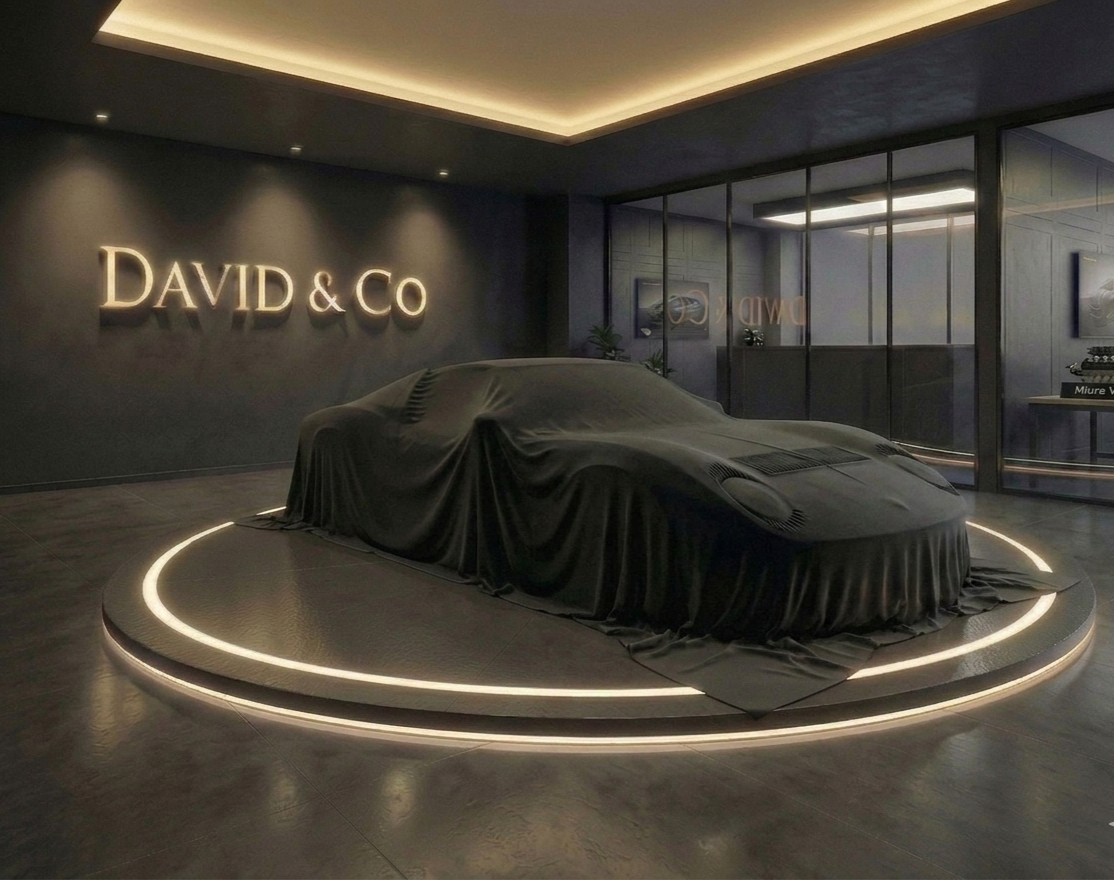
This exceptional European-market example presents in ultra-low mileage condition with matching numbers throughout — engine, gearbox, and body numbers all correlate correctly to the factory build record. Full documented provenance accompanies the vehicle, including service history, original manufacturer's data, and a certified history dossier. A subject of careful and appropriate preservation rather than heavy restoration, this Miura represents exactly the standard of correctness and integrity that the international collector market demands.
Matching Numbers & Provenance: In the classic car investment market, the phrase "matching numbers" is not mere terminology — it is the single most significant determinant of a vehicle's authenticity, value, and saleability. This Miura's engine, gearbox, and chassis numbers have been verified as correct and original to the car. Full provenance documentation is available to verified buyers under NDA.
The Miura's engineering achievement cannot be overstated. By placing the engine transversely amidships, Lamborghini achieved near-perfect weight distribution at a time when Ferrari and other rivals still mounted their engines at the front. The 3.9-litre quad-cam V12 breathes through six downdraft Weber carburettors and produces a sound — that ascending, layered V12 shriek — that no recording has ever fully captured. At speed, the Miura is visceral, communicative, and demanding in a manner completely alien to modern supercars.
On the collector and auction market, authenticated, low-mileage Miuras with correct numbers and documented history consistently achieve €2,000,000–€4,000,000 at the world's major auction houses — RM Sotheby's, Bonhams, Gooding & Company — with SV variants at the higher end of that range. This off-market example, available exclusively through David & Co, represents a rare opportunity to acquire a significant piece of automotive history at the highest level of collector integrity.
| Make | Lamborghini |
| Model | Miura (Variant disclosed upon enquiry) |
| Production Years | 1966–1973 |
| Engine | 3.9L Transversely-Mounted Quad-Cam V12 — DOHC per bank |
| Displacement | 3,929 cc |
| Induction | Six Weber 40 DCOE Downdraft Carburettors |
| Power Output | 385 hp / 287 kW (SV specification) |
| Torque | 400 Nm |
| Transmission | 5-Speed Manual — Integrated with Engine |
| Drive | Rear-Wheel Drive |
| Top Speed | 280 km/h (factory claimed) |
| 0–100 km/h | Approx. 6.7 seconds |
| Body | Hand-Beaten Aluminium — Designed by Marcello Gandini / Bertone |
| Weight | Approx. 1,250 kg |
| Numbers | Matching — Engine, Gearbox & Chassis Verified |
| Mileage | Ultra-Low — Disclosed to verified buyers |
| Condition | Collector Grade — Preserved / Appropriately Restored |
| Registration | European — EU Road Legal |
| Location | Europe (disclosed to verified buyers) |
| Provenance | Full documented history — available under NDA |
| Total Production | 764 examples (all variants) |
| Price | Price on Request |
All enquiries handled with complete discretion. Response within 24 hours. David & Co donates 10% of every fee to a Hungarian charity of your choice.
Additional high-resolution images, full factory data plate photographs, engine bay documentation, and independent inspection reports available to verified buyers upon request.
Lamborghini produced a total of 764 Miuras between 1966 and 1973, across three principal variants: the P400 (275 units), the P400 S (338 units), and the P400 SV (150 units). The SV is the rarest, most developed, and most sought-after variant on the collector market, commanding the highest prices at auction.
The Lamborghini Miura is widely and accurately considered the world's first true mid-engine production supercar. Unveiled at the 1966 Geneva Motor Show, it debuted a transverse rear-mid-mounted V12 layout that established the fundamental architecture of virtually every supercar since — including those of Ferrari, Porsche, McLaren, and Bugatti. Its Marcello Gandini–designed body is consistently cited as among the most beautiful automotive designs in history.
The original P400 (1966–1968) was the debut model. The P400 S (1968–1970) introduced improved interior quality, stronger engine internals, and wind-up windows. The P400 SV (1971–1973) — the definitive variant — featured a revised engine with a split sump for better lubrication, uprated power to 385 hp, improved independent rear suspension, a wider rear track, and distinctive wider rear arches without the eyelash vents. The SV is the mechanical and collector pinnacle of the Miura range.
Matching numbers means that the vehicle identification numbers on the engine, gearbox, and chassis all correspond to the factory production records for that specific car — confirming that no major components have been replaced with those from another vehicle. For a classic as significant as the Lamborghini Miura, matching numbers is the single most critical determinant of value, authenticity, and long-term investment integrity. A non-matching Miura can command 30–60% less than a correctly-numbered example in comparable condition.
Yes. This European-specification example is fully road legal and EU registered. Classic vehicles of this period are typically subject to historic vehicle registration and exemptions rather than modern emissions requirements, allowing them to be legally operated on public roads throughout the EU. Practical usage is naturally limited by the car's rarity and value.
Auction results and private market transactions in 2023–2025 place authenticated, matching-numbers Miuras in the €1,500,000–€4,000,000 range depending on variant, condition, colour, mileage, and provenance quality. P400 SV examples in exceptional condition with ultra-low mileage and complete history regularly exceed €3,000,000. Prices have risen substantially over the past decade and are expected to continue appreciating given the car's irreplaceable historical significance.
The Lamborghini Miura is consistently cited by major auction houses, classic car investment funds, and independent analysts as one of the world's most reliable classic car investment assets. Its combination of absolute historical significance (first supercar), extreme scarcity (764 total), universal aesthetic recognition, and growing global demand from collectors in Europe, the Americas, and Asia make it a benchmark asset within the alternative investment universe. The Knight Frank Luxury Investment Index has repeatedly ranked rare classic Lamborghinis among the top-performing tangible asset classes globally.
Yes. We coordinate fully insured international transport, EU export documentation, customs clearance, and global delivery for all vehicles. The Miura will be transported using specialist enclosed carriers with climate control, air-ride suspension, real-time GPS tracking, and insurance coverage appropriate to the vehicle's market value. We have successfully handled deliveries to buyers across Europe, the Middle East, Asia, and North America.
Absolutely. Confidential in-person viewings and independent third-party inspections — including assessments by Lamborghini-specialist engineers and recognised marque historians — can be arranged for verified, qualified buyers upon request. Full technical inspection, chassis verification, and provenance review are standard elements of our acquisition process for a vehicle of this significance.