

The name Nuvolari belongs to one of the greatest racing drivers in history. Tazio Nuvolari — the Italian whose genius Ferdinand Porsche called "the greatest driver of the past, the present, and the future" — won the 1932 AIACR European Championship representing the four rings of Auto Union. In giving his name to this car, Audi is making a statement: the Nuvolari is not just another fast road car. It is the most concentrated expression of everything the brand has learned across a century of motorsport.
With 1,001 PS from a hybrid system combining a Lamborghini-derived V8 — revving to 10,000 rpm — with three axial flux electric motors, a top speed exceeding 350 km/h, and a body built from carbon fibre using techniques borrowed directly from Formula 1, the Nuvolari is the car Audi has been building towards since the original quattro rewrote the rules of performance in 1980. And with just 499 examples to be made, it is also one of the most significant collector opportunities of the decade.
What Is the Audi Nuvolari?
The Nuvolari is Audi's first true hypercar — a mid-engined, two-seat plug-in hybrid supercar that sits above everything else in the brand's lineup and serves as the spiritual successor to the Audi R8. It is built on a new Audi Space Frame (ASF) with a carbon fibre exterior, making it the most advanced body structure Audi has ever put into production. Its design follows Audi's new philosophy — called "The Radical Next" — built around four principles: clear, technical, intelligent, and emotional.
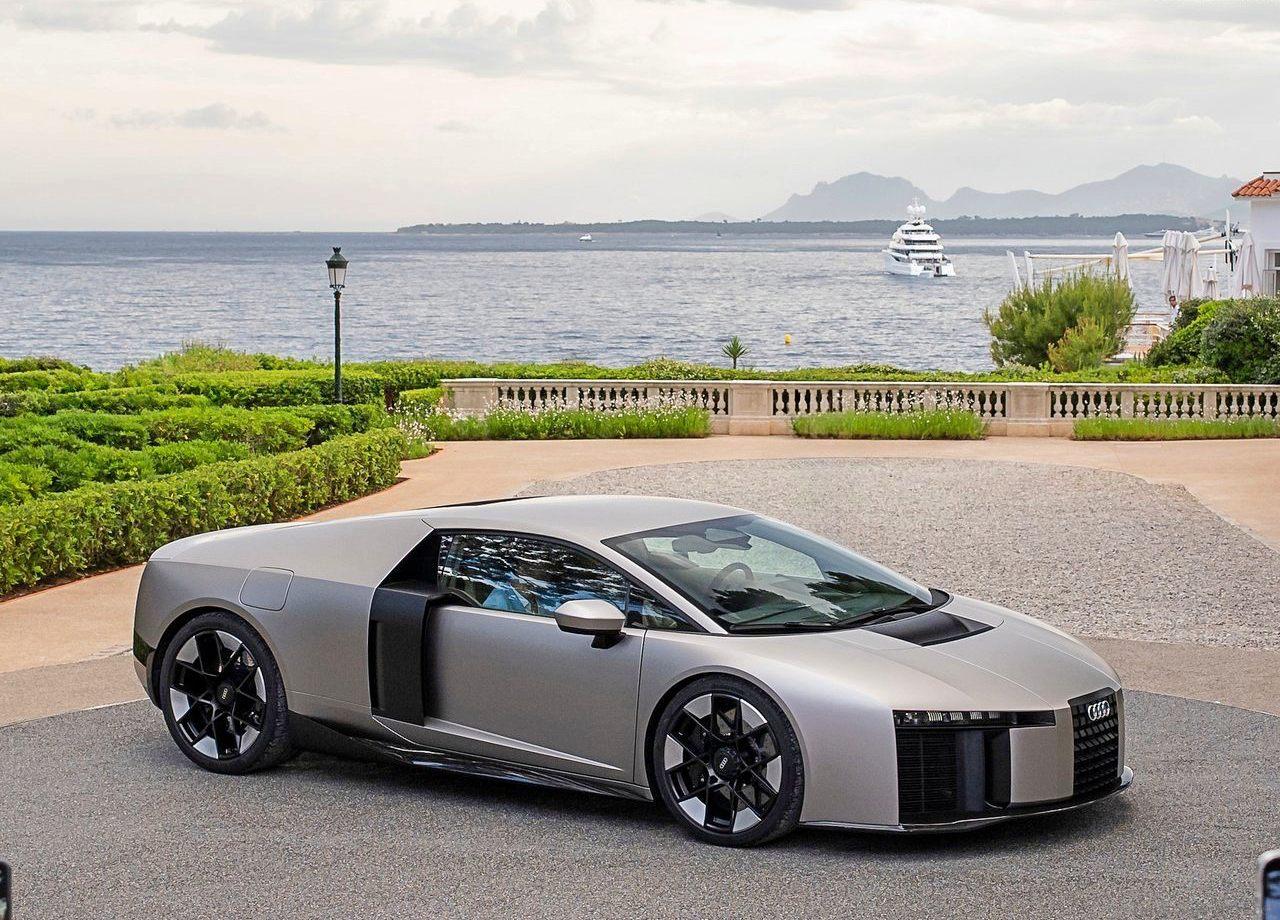
The exterior has a monolithic, sculpted quality derived from the Concept C show car revealed in 2025, and shares the same bespoke Titanium signature colour used on Audi's Formula 1 race car. The rear window was eliminated entirely in favour of side-mounted air intakes — a functional decision that also defines the car's most distinctive visual signature. Four horizontally arranged lighting elements at the front and rear are immediately identifiable. A deployable rear wing manages aerodynamic balance automatically, rising for downforce and retracting for low-drag efficiency.
Audi CEO Gernot Döllner describes the Nuvolari as a car that emerges from the brand's Formula 1 programme — Audi entered F1 in 2026 — and represents a direct transfer of racing technology to a road car. The timing is not coincidental: the Nuvolari is Audi's most compelling statement that the four rings still stand for something visceral, precise, and genuinely extreme.
"With the Audi Nuvolari, we are accelerating technological progress — focusing on technology, performance, and execution through teamwork."
— Gernot Döllner, CEO, Audi AG
Powertrain & Performance — The Numbers
The Nuvolari's powertrain is unlike anything Audi has previously offered. At its core is a 4.0-litre twin-turbocharged V8 — the Lamborghini L411 unit, co-developed across the Volkswagen Group — producing 800 hp (588 kW) and 730 Nm of torque. But what sets this engine apart from any road-going V8 in Audi's history is its redline: 10,000 rpm, a figure previously reserved for motorsport. The V8 is mounted in a mid-engine configuration, defining the Nuvolari's proportions and placing the heaviest mass as close to the car's centre as possible.
Three axial flux electric motors — the most power-dense electric motor architecture available, used in motorsport for its exceptional power-to-weight ratio — complete the drivetrain. Two oil-cooled axial flux units at the front axle together deliver up to 2,150 Nm of torque to the front wheels, enabling variable torque distribution as part of the quattro all-wheel drive system. A third electric motor sits between the V8 and the transmission, providing instant hybrid boost at any throttle input. Combined system output: 736 kW / 1,001 PS.
The energy storage system is a 7.3 kWh lithium-ion battery — compact by EV standards, but purpose-matched to the hybrid architecture. It enables short-range fully electric driving and, crucially, sustained hybrid performance without the weight penalty of a larger pack. The result is 0–100 km/h in 2.6 seconds, 0–200 km/h in 6.8 seconds, and a top speed exceeding 350 km/h.
Chassis technology is equally ambitious. Quattro predictive ride — Audi's most advanced all-wheel-drive system — uses forward-looking sensors to anticipate driving conditions and adjust torque distribution between all four wheels before the driver even feels a change in grip. A brake-by-wire system blends regenerative braking with high-performance disc brakes, the discs designed to absorb extreme energy without overheating under repeated hard braking.
Exterior Design — Carbon, Titanium, and No Rear Window
The Nuvolari's body is built from the new Audi Space Frame with carbon exterior — the most advanced body structure in the brand's production history. Carbon fibre components are manufactured using Formula 1-derived techniques for maximum strength and minimum weight, while also being designed for heat resistance under sustained high-performance driving.
The design language is monolithic: a single, continuous volume, muscular from every angle, with taut surfaces interrupted only by functional aerodynamic elements. The most radical decision was eliminating the rear window entirely, replacing it with side-mounted air intakes that feed the V8 mid-engine behind the cabin. The result is a rear three-quarter view unlike any production car in Audi's history — resolved, closed, and entirely purposeful.
The signature Titanium paint — developed specifically for Audi's Formula 1 car and first seen on the Concept C — is the defining colour of the Nuvolari's reveal. In combination with carbon elements, it creates a surface that appears to shift tone between matte and metallic depending on light and angle. The four horizontal lighting elements at the front and rear are immediately identifiable as the Nuvolari's face — a clean, technical signature that will define Audi's new design era.
Interior — Driver-Centric, Historically Inspired
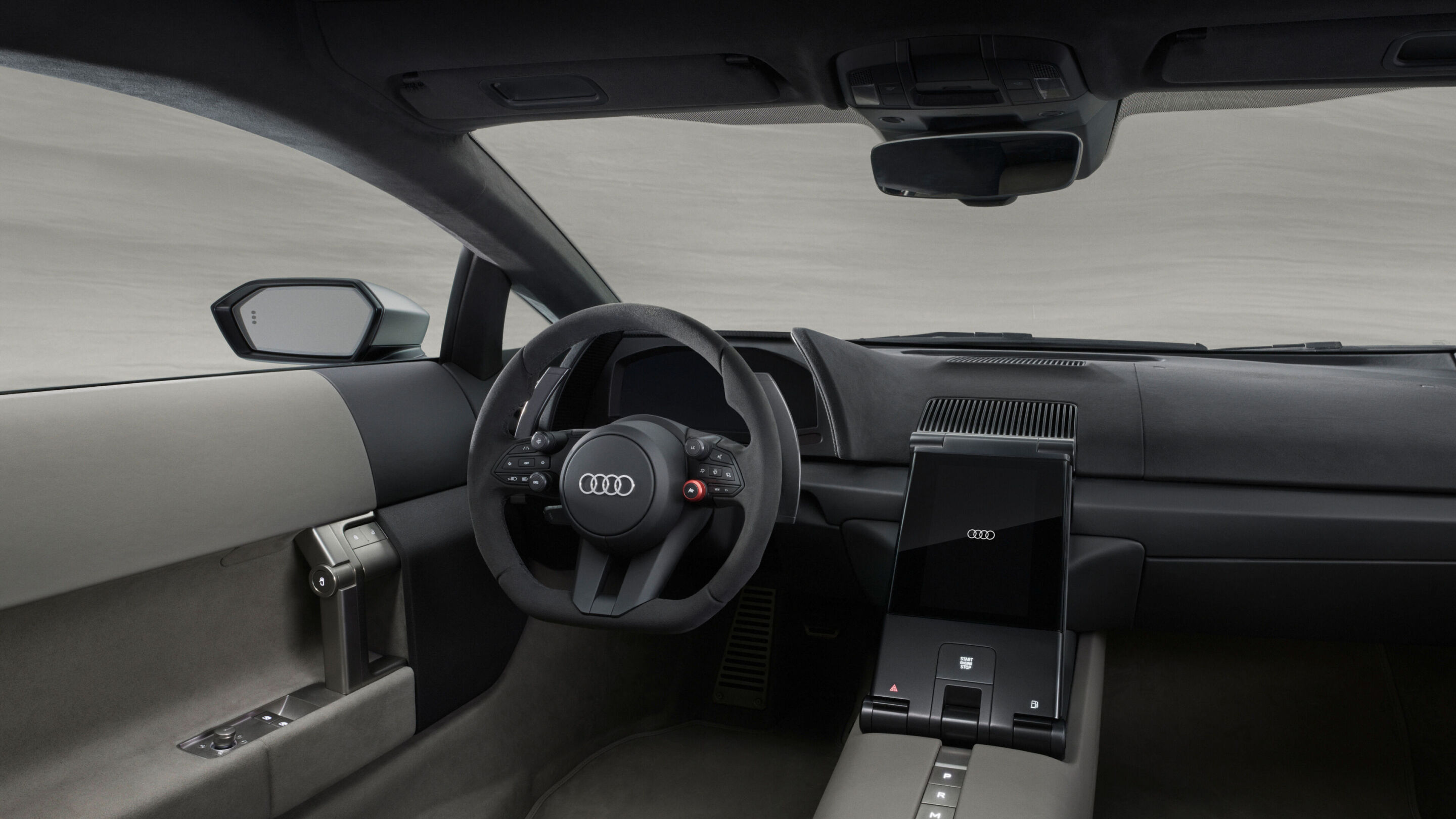
Audi has released limited interior imagery, but the direction is clear: the Nuvolari cabin is built around the act of driving. The philosophy Audi describes as "fully focused on the driver" means every interface has been evaluated for relevance and immediacy. Digital displays and physical controls follow a consistent logic, enabling what Audi calls natural interaction — the driver reaches for what they expect, and it is there.
A central portrait infotainment screen is paired with a select number of large, chunky physical controls — deliberately contrasting with the haptic-heavy touchscreen interfaces that have proliferated across the automotive industry. The colour scheme of the digital displays references the 1930s Auto Union Type C race car — the historic Auto Union that Tazio Nuvolari drove to victory, connecting the car's present to its deepest roots. Two-tone upholstery reinforces the minimalist, utilitarian character.
The Nuvolari is a two-seater, and the cabin proportion reflects this: the architecture is narrow, focused, and stripped of anything unnecessary. It is a car built for the driver's experience first — as close to a racing seat as Audi has ever offered on a road-registered vehicle.
Full Technical Specification
| Model Name | Audi Nuvolari |
| Body Style | Mid-Engine, 2-Seat Plug-In Hybrid Supercar / Hypercar |
| Body Structure | Audi Space Frame (ASF) with Carbon Fibre Exterior |
| Combustion Engine | 4.0L Twin-Turbocharged V8 (Lamborghini L411) |
| V8 Output | 800 hp / 588 kW — 730 Nm torque |
| V8 Rev Limit | 10,000 rpm |
| Electric Motors | 3 × Axial Flux — 2 front axle (110 kW each), 1 between engine & gearbox |
| Front Axle Torque | 2,150 Nm (combined front motors) |
| System Output | 736 kW / 1,001 PS (987 bhp) |
| Drivetrain | quattro AWD — quattro predictive ride torque vectoring |
| Battery | 7.3 kWh Lithium-Ion |
| 0–100 km/h | 2.6 seconds |
| 0–200 km/h | 6.8 seconds |
| Top Speed | 350+ km/h (217+ mph) |
| Aerodynamics | Active — Vertical Frame (64 tiles), deployable rear wing, concealed S-duct |
| Braking | Brake-by-wire — regenerative + high-performance discs |
| Rear Window | None — replaced by side-mounted air intakes |
| Lighting | 4 horizontal elements front and rear |
| Signature Colour | Titanium (bespoke — shared with Audi F1 car) |
| Interior Focus | Driver-centric — portrait screen + physical controls |
| Interior Reference | 1930s Auto Union Type C race car colour scheme |
| Production Limit | 499 units — worldwide |
| Assembly | Audi AG, Germany |
| Expected Price | £500,000+ (Europe — not officially confirmed) |
| First Deliveries | H1 2027 |
The Audi Nuvolari as a Collector & Investment Asset
The Nuvolari is a strictly limited production vehicle: 499 units, worldwide. This is not an artificial allocation imposed after launch — it is baked into the car's DNA from the outset. Audi has been emphatic that these 499 examples represent the entirety of Nuvolari production. There will be no second run, no special edition, no continuation series. When they are gone, they are gone.
The historical significance compounds this scarcity. The Nuvolari is the first true hypercar Audi has produced — not a performance saloon, not a fast SUV, not a sports car in the R8 mould, but a genuine hypercar competing with the Lamborghini Revuelto, the Ferrari 296 Speciale, and the McLaren W1. It is the opening chapter of Audi's "Radical Next" design era, making it — like the first-generation quattro, the original R8, and the Le Mans quattro concept — a historically significant moment in the brand's timeline that early-delivery examples will permanently represent.
The collector calculus is clear: 499 units, hypercar territory pricing, first-of-era status, Formula 1-derived technology, and no successor announced. Comparable vehicles — the Lamborghini Sian, the McLaren Senna, the Ferrari LaFerrari — all demonstrated significant secondary market appreciation from their first years of delivery. The Nuvolari's combination of genuine engineering significance and documented scarcity places it firmly within this category.
Secure an Audi Nuvolari Allocation — David & Co
David & Co is currently accepting enquiries for Audi Nuvolari allocation positions. With only 499 units produced globally and deliveries beginning in H1 2027, early allocation slots represent the only route to first-wave delivery. Our team works directly with verified buyers to secure and manage allocation positions with full factory personalisation access.
Audi Nuvolari — Frequently Asked Questions
What is the Audi Nuvolari?
The Audi Nuvolari is Audi's first true hypercar and the most powerful and fastest production vehicle in the brand's history. It is a mid-engined plug-in hybrid supercar powered by a 4.0-litre twin-turbocharged V8 producing 800 hp paired with three axial flux electric motors for a combined 1,001 PS. It does 0–100 km/h in 2.6 seconds, exceeds 350 km/h, and is limited to 499 units worldwide. The name honours Italian racing driver Tazio Nuvolari, winner of the 1932 AIACR European Championship.
How much does the Audi Nuvolari cost?
Audi has not officially confirmed a price, but industry sources expect the Nuvolari to start upwards of £500,000 in the UK, placing it squarely in hypercar territory alongside the Lamborghini Revuelto and Ferrari 296 Speciale. Given the bespoke nature of the car, its 499-unit production limit, and the level of customisation available, on-the-road costs will vary significantly by specification and market.
How many Audi Nuvolaris will be made?
The Audi Nuvolari is strictly limited to 499 units worldwide. This is a hard production cap confirmed by Audi — no continuation run is planned. Deliveries are expected to begin in the first half of 2027. This makes the Nuvolari one of the most documented scarce Audi production vehicles ever made.
What engine does the Audi Nuvolari have?
The Nuvolari uses a hybrid system combining a 4.0-litre twin-turbocharged V8 (the Lamborghini L411, producing 800 hp / 588 kW and 730 Nm, with a 10,000 rpm redline) with three axial flux electric motors — two at the front axle producing up to 2,150 Nm combined, and one between the V8 and the transmission. A 7.3 kWh lithium-ion battery supports electric driving and hybrid boosting. Combined output is 1,001 PS / 736 kW.
How does the Audi Nuvolari compare to the Lamborghini Temerario?
Both cars use the same 4.0L V8 engine architecture (Lamborghini L411) but develop it differently. The Temerario uses a high-revving naturally-inspired tune; the Nuvolari pairs the biturbo version with three electric motors for a total output advantage. The Nuvolari is the more powerful and faster car. More importantly, the Nuvolari is limited to 499 units versus the Temerario's broader production run — making it significantly rarer from a collector perspective. Price positioning is also different, with the Nuvolari sitting above the Temerario.
Is the Audi Nuvolari a good investment?
The Nuvolari presents a compelling collector investment thesis. As the fastest and most powerful production Audi ever made, limited to just 499 examples, it carries documented historical significance as the first car of Audi's new design era. Comparable limited hypercars — the Lamborghini Sian, McLaren Senna, Ferrari LaFerrari — demonstrated consistent early secondary market premiums. Early allocation positions, secured through specialists like David & Co before production fills, represent the strongest entry point for collectors seeking first-delivery timing.